Episode Transcript
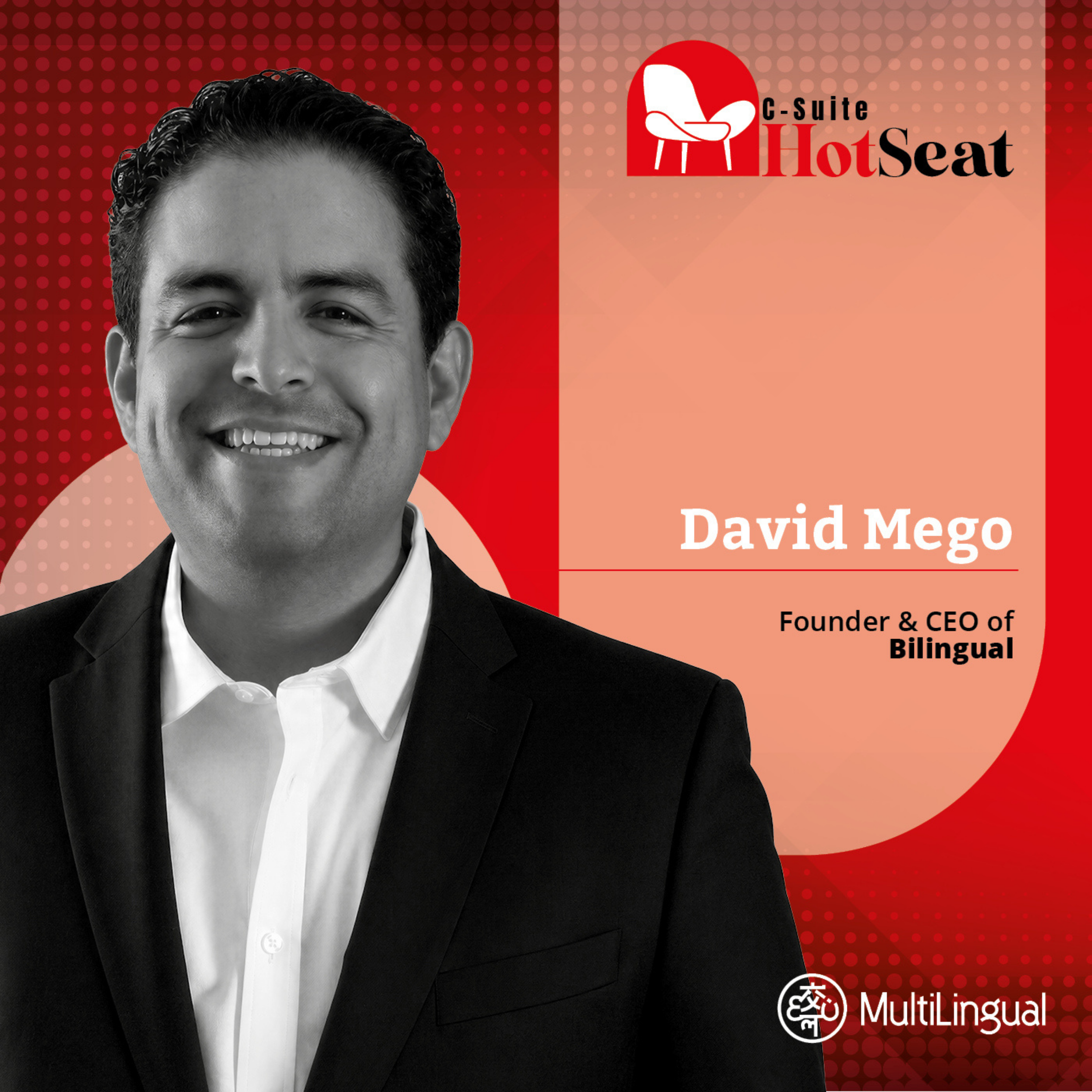
[00:00:08] Speaker A: Welcome to the C Suite Hot Seat, the show where we put the industry leaders in the chair and ask the questions that normally stay off the slide deck. With us today, we have an amazing guest. Before that, I'm Eddie Arrieta, CEO at Multilingual Media. And today we're talking with an entrepreneur who's built a company around a simple but powerful observation. Latin America's bilingual talent shouldn't be viewed only as an individual skill. It can be built into a global business capacity. Our guest is David Mego, founder and CEO of Bilingual.
David built the company on the idea that Latin America could become a major hub for multilingual service delivery.
Today, Bilingual operates more than 1500 seats across countries, including Peru, Argentina, Ecuador, Colombia, El Salvador, and Mexico, supporting more than 100 language pairs and combining interpretation and customer service outsourcing within a single operation. But David's path to building the company wasn't a straight line. His earlier ventures taught him some expensive lessons about execution discipline and what it actually takes to turn an idea into a scalable business. Today, we are talking about entrepreneurship failure, company culture, scaling across Latin America, and economics of bilingual talent and what it takes to build an organization capable of competing globally. David, welcome to the Hot Seat. How are you doing today?
[00:01:49] Speaker B: Hey, thank you, Eddie. Thank you for inviting me to be part of the Hot Seat.
[00:01:54] Speaker A: Good to see you, and it's great to see you, my friend. Of course. Last time we saw each other was in Puerto Rico at the ALC conference. What has happened on your end since then? What's going on with Bilingual and with you?
[00:02:09] Speaker B: Well, a lot of travel, I can say so. Typically, I'm on a plane every two weeks somewhere, either visiting customers, visiting operations.
But yeah, there's been a lot, a lot of travel and nothing in a nutshell trying to oversee, you know, the sales part of the company and trying to make sure that we bring in the right talent to the company. My. My. My main job is to make sure that I bring in the proper leaders to build and lead the company.
[00:02:50] Speaker A: Fantastic. And how about we take a look at that just to let our audience take an interesting take on what a CEO actually does. David, so what do you do? You do a lot of travel? Of course. You're not alone. You have an amazing group of people that work with you. Can you give us a little bit of light into how that works for you?
[00:03:14] Speaker B: What do I do now?
It's a lot different what I do now than what I did back when we started 16 years ago. Right.
When I started 16 years ago, it was easy.
It was easy to be number one when you're the only one, right.
Rebecca and I, my business partner and sister, we're the ones answering the phone, quoting, and she would go and do the interpretation or vice versa.
And we did it. So.
And I had to do the invoicing, I had to do all the work orders and so on and so forth.
Now things have changed. Now there's people that do all those different operations. And my role, like I mentioned earlier, is to make sure that I built the team right, the team that actually is able to lead all the rest of the staff to make sure that the company continues growing. I obviously focus on the leader, making sure that my leadership team is we're all sync and going in the right direction or the company's direction where we want to go to.
[00:04:33] Speaker A: And this is wonderful. Of course, a lot of what you've built is based on an idea you talked about and stated the observation that bilingualism in Latin America was treated as a personal skill rather than a capacity that could be sold globally. When did you first realize that observation and that there was something hidden there and there was like actually business to be, to be made from it.
[00:05:01] Speaker B: So, you know, I come from the interpreting background. I've been in the interpreting world for the last 22 years. I myself was an interpreter for a company back in the days called Network Omni. You know, it was Network Omni and language line that would be neck to neck all the time.
And I worked for Network Omni as an over the phone interpreter. And that's where I got introduced to this whole industry. Right.
But that was only the professional side. I had been interpreting for my parents back when we lived in the US since I was 8 years old. So I did not know that there was industry behind that. Right. So like I said, my sister and I would go ahead and interpret for my parents for different scenarios. A scenario that still happens now in the US A lot of kids of immigrants who are limited English speakers are doing the role of an interpreter.
Should they?
No.
But it's something that's happening, right?
And that's how, you know, who knew that the little thing that I was doing interpreting for my parents, 10 years later I would actually get a job and I would get paid.
I would get paid to do it and help so many families and communities. You know, I've helped kids, mothers give birth.
I've had to give a really bad news to a family member for health reasons or XYZ situations to help companies collect their money, their dues, right. So it's a beautiful industry in the interpreter industry, what we have here.
So it was pretty natural for me to switch from being an interpreter at Network Omni and start my own endeavors and say, hey, we could do this. There's a lot of talent, there's a lot of bilingual talent in the region. And typically interpreters were only catering for domestic markets. Right. We've worked with mining companies, telco companies, insurance companies, capital investment firms, banks, locally and.
But the bilingual talent was not being exported. And that's what we've done. We exported bilingual talent to the U.S.
okay. We started in Peru, we started very, very small. It was just my sister and I and a little dining room table from my mother's house with a compact computer. You know, the compact is gone, long, long time ago. And a little, and a cordless phone and I had a little yellow book ad this big and the rest is history. No, we're multi country operational company, over a thousand employees located across these regions.
12 core languages.
But we do provide through the interpreter network the remaining hundreds of languages that are available for the industry.
So yeah, I'm sorry, I sidetracked.
Did that answer your question?
[00:08:29] Speaker A: Definitely, definitely. And you know, when you have an amazing story, and I'm sure our viewers or listeners appreciate the backstory, you know, things change significantly. And for you, you know, going from your mother's kitchen table to the international, let's say dining rooms of the executive, many things have changed.
Hundred seats now. What did you say has become significantly harder as you evolve at that scale? You know, it's not just you and your sister with a tiny ad now. You know, you advertise in many different places, you are part of different associations, you actively coach other entrepreneurs, you are part of executive communities.
What has changed? What is harder now and what does it look like to have a company of that scale? Scale.
[00:09:20] Speaker B: So it's definitely communication and consistency, making sure that, you know, when you're a hundred employees, it's pretty easy because you know everybody, you know everybody's name, you know, everybody's different situations.
But as you grow locally and then you go to different Geos, you need like something that we really focus on is that regardless of where you are, if you work for bilingual, you feel the same culture.
So the team in Argentina has the same employee experience and the team in Colombia or in Peru.
Now there's things that are very domestic for each geo. Okay, but, and they're, they're sort of tailor made for each geo. But, but the core culture is there, right? We have Four very strong values, which is our PISA values. Okay. Productivity, integrity, service and adaptability.
So those are embedded in the management team and middle management team and making sure that that communication and consistency is there.
You know, whether when we were a hundred and now over a thousands or when we're 5,000, it's, it has to be there. So we have to create those environments where that piece of the culture doesn't get lost, where communication is consistent and that, you know, all the things are in place to when that growth happens.
[00:11:09] Speaker A: And this is true, of course, for, you know, a lot of our audience members who are in different parts of Latin America. And it's great to have you with us, David, because you are one of the biggest, if not the biggest advocate for Latin American talent.
And there are a lot of misconceptions around Latin American talent. What we, because as we are Latin American talent, what we represent.
What do you think the global language industry stands still misunderstanding about what Latin America has to offer?
[00:11:40] Speaker B: The misunderstanding is that Latin America should be looked at as a global delivery region.
Okay. People tend to say, oh, Latin America is only for Spanish. And that's a very, very limited view. Okay. There's real opportunity for combination of bilingual talent not only for Spanish. We do French, German, Japanese out of Latin America. Okay.
Cantonese, Mandarin. So there's, there's so much more than just Spanish in Latin America. Okay. Benefits of being in America, the proximity to the, to North America, you know, to the US the culture, affinity.
We've all seen France in some, all the countries in Latin America seen France. So, you know, just the, the time zone alignment as well and the professional workforce. I think the region shouldn't be viewed just as a low cost labor geo. Right?
It should be looked at as a global services hub. And I think that's where we come in because we're not, you know, we are no longer offering only language services. We offer BPO services and customer service outsourcing services and there's a whole portfolio of other additional services that we're offering.
And we know that our main skill, or our main, yeah, our main skill is management of bilingual talent.
So can someone that's bilingual work for a company as an interpreter? They could also work as a virtual assistant. They could also work as a PA and software programmer.
So I think that should be how Latam should be looked at. Right? It should be looked at as a
[00:13:57] Speaker A: global service hub and that is wonderful. I'll ask you a little bit more about language services, bpo, customer service, outsourcing and the combination.
But Before I get to that, I want to ask you about your perception as an executive.
Things have changed in the past few decades of how people talk to you as an executive. You've seen an evolution. Do you think things are improving in how they perceive Latin American talent? And Latin American companies looking at us more seriously, if we want to put it that way, or at least be more open to providing us with the biggest challenges rather than with, you know, some side projects and smaller contracts.
[00:14:42] Speaker B: So it is true, it's changing. Okay. And typically Mexico was the GEO to outsource to, right? There was either Mexico, Panama, Costa Rica or Dominican Republic. Those were the hubs of outsourcing for the US Colombia has come in and has become a great operational hub for outsourcing, not only language services, but all the other services as well in the BPO world.
But the perception of Latin America is changing. Why? And the pandemic helped a lot. Okay. And it helped because customers didn't have another option. Typically customers that were outsourcing anything, whether it be a BA or a PA or you know, or some sort of programmer who was, who were outsourcing to the mid, to the Middle east or Asia.
When the pandemic hit, the work at home infrastructure that they had was not the one, the minimum required.
Right.
And customers needed to flee.
And where did they look? They're like, oh, there's about, you know, a billion people in close to me and I think I need to source there. And very quickly the pandemic helped to shift that view. Now I'm not saying people have stopped outsourcing to Asia, but the mix is, is there right before where Latam was not even looked at and it was not. If I'm going to go outsource, I'm going to go to Middle East, I'm going to go to Asia. Now they say, hey, I'll keep a portion of my pool in Latam, a portion in Asia, a portion in the Middle east and so on and so forth in Africa.
So yeah, I think we are still getting there.
Okay.
But there's saturated markets within Latin America. Costa Rica is a very saturated market.
Mexico it is as well. Colombia it is as well. But there's a lot of other GEOs that are still growing and expanding. Peru, it's still expanding, still growing.
[00:17:06] Speaker A: That is wonderful to hear and to see that there is still a lot of opportunities for Latin Americans and around the world bilingual. The work that you do combines interpretation and customer service outsourcing. Do you see the traditional boundaries between language services and bpo? Becoming less relevant. Especially now in these years of AI, we want to call them that.
[00:17:29] Speaker B: Yeah, absolutely. So clients don't really care which category we put ourselves in. Okay.
They have a business problem and they need it solved.
That's it. Right. So. And they want to talk to less and less vendors. We have partners that had 25 vendors, very large, 25 vendors. So there's a lot of issues that you have to manage and they have whole structure for vendor management there.
But when you start offering multiple services, for example, let's say a healthcare organization requires OPI services. Right.
But we could also do their scheduling service to make sure that the appointments are being set up. So instead of talking to two different companies, to a language company or to a bpo, they could just talk to one. Right. Or even the back office support that they need, you know, patient feedback or patient engagement, that can also be outsourced.
So, yeah, typically those services, like I said, they used to be bought by different vendors.
Even nurse staffing. Right. Or medical staff staffing.
That is things that we are consolidating.
And ideally, we want to be the partner where the customers come in and say, hey, I need this. Do you have it? We do. And we have. And we've been doing it for AYC reason. And this is from our start. We have that in our DNA. Okay. When we started, we used to do only on site interpreting.
Okay.
And we would go to the mines, we would do simultaneous interpretation at conferences, and customers would come and say, hey, but you, you already do the interpreting for me. Why don't you do the translations?
And to be honest, I'm not a translator, so I can't translate. And my, you know, I would type with, with two fingers. There's no way I would be able to, to do a translation. But we listened to our customers and we brought in a team to build the transitions department.
And that has happened with all the multiple services that we ended up providing and servicing.
[00:20:03] Speaker A: Thanks for giving us some perspective into what clients want. Because at the end of the day, the buyers are the ones that decide, you know, what your services are.
I am sure that it's not being. And when you look in retrospect, everyone is like, oh, it's so easy for you now. You've got 1500 seats. Probably you're gonna be at five soon. You have so many countries in Latin America. It was probably so easy for our audience. Those that are watching this, those that are listening, can you tell us a little bit about, you know, some of the values in terms of resilience and adaptability that have helped you be where you are at right now as an entrepreneur, as, as a leader in, in the company.
[00:20:45] Speaker B: Resilience and adaptability and service and productivity. Those, those are the four values of bilingual. And I think we've lived them throughout different scenarios, right? Productivity.
We were there asking clients what they needed.
We weren't sitting and waiting for them to tell us, hey, I need this, I need that.
We would see within their operations, hey, they're needing this. We would suggest it. We'd be productive about it. You know, if we would see their volume going down, we would adjust for XYZ reason. And when the client actually would say, hey, I need to do a change in my staffing, we're like, don't worry, it's done. And they're like, huh.
So productivity is key to make sure that the relationships with the, with the clients or partners is actually strong.
Right?
You should be able to trust your partner. Your client needs to be able to trust you.
And I think that, that, that is key. Adaptability.
Hey, client says, I screwed up, I need you to help me out. I need, I forgot to schedule, you know, this, this and that.
Make sure that we are able to deliver and solve the problem for them. Okay.
Service.
The same thing as I remember a very classical scenario. We were at an on site interpretation dig and it was a board meeting for a very large company.
And the, the executive assistants were the ones responsible for setting up the interpretation booth and everything, right?
And the receivers and so on and so forth. And we would help them set up the, the main, it was like a 30 people or 40 people boardroom board table and you know, setting everything up, putting up the notepads, the pens, the bottles of water. And it was, it wasn't our job to do it right, but the service factor that we have is like, I'm gonna help you, I'm gonna help you look good.
And, and when the room would happen and one of the executive assistants said, you guys, the reason I call you guys, because you guys are different. We have hundreds of interpreters that come in and just stand in the corner and they're like, you know, let me know when everything's set up.
And we're not like that. So I guess that's, that's what we do.
[00:23:36] Speaker A: And thank you because that gives us an idea of, you know, where those values actually help with the growth of the company and take you where you're at today. Now we are onto a section that is one of my favorite sections and probably one of Our favorites for our audience, which is the rapid fire section. So we are expecting short answers here. And let's see what you have for us, David, if that's okay with you.
And to begin with, what's the first sign that a company's culture is beginning to break as it scales?
[00:24:10] Speaker B: When they say, it's not my job.
[00:24:14] Speaker A: That is a good one.
[00:24:15] Speaker B: So typically, when you're small, you got to do everything right. You gotta sell, you gotta collect, you gotta do work, order purchase orders.
You gotta do the service and then come back.
But when you grow, you need to put in processes. You know, the ISO certifications, I remember, we have them. Okay. But it was a cultural change to organize the company. Yes. We needed it because we needed those processes. Right.
But yet processes should not.
I forgot the word in English. They shouldn't, like, create layers of difficulty coming the way into the operations. Right.
They need to create accountability so. Not excuses. And at the end of the day, we owe all ourselves to our clients, so it's all of our responsibility if something goes wrong. So it's not.
It's not just a single department or. Because it's very easy when something goes wrong to everybody point a finger. Right, Right. But when everything's going good, everybody's celebrating, and we're like, oh, we're all a team. It's all of us. We all made it. But when something goes wrong, they're like, oh, they screwed up.
So, yeah, your job. That's the first sign when they start saying, it's not my job, it's not my responsibility. It's not in my job description.
Whatever.
[00:25:52] Speaker A: Red flag.
[00:25:54] Speaker B: There we go.
[00:25:55] Speaker A: What's something about managing people that entrepreneurship taught you the hard way?
[00:26:00] Speaker B: Ooh, that one's easy. Keeping the wrong people. Or I'm sorry, maybe I should say, yeah, keeping the wrong people in the wrong position for kindness.
[00:26:12] Speaker A: Oh, look at you. Yes. Yes. Thank you. Keeping the wrong people in the wrong place for kindness. Just be nice. Just be nice. Don't do that. What's the hardest leadership decision you've had to make in the last year? Or we can say last decade. That's okay. It doesn't have to be the last year.
[00:26:33] Speaker B: It's just that what I was saying earlier, I had to fire people that you like.
[00:26:40] Speaker A: Having to fire people that you like, that you wanted to be nice with. And you're like, okay.
[00:26:43] Speaker B: And. And. And it's not only being kind, because I really believe that I, you know, that they could do it, that, you know, that they wanted to. I wanted them to succeed. I gave them the tools. I gave them everything. But eventually, this is what happens when you have someone in the team that's a weak link. The whole team suffers because they're going to subsidize that, you know, what they're not being good at, and it impacts the whole team. So, yeah, I learned that. And it's still something that I need to practice more. I guess.
[00:27:18] Speaker A: That's it. That's it.
Something. What's the hardest no you've had to give as a CEO?
[00:27:25] Speaker B: See, the hardest no is saying no to revenue. Oh. So sometimes we, you know, when did the logo, we're like, yes, but no.
Sometimes you have potential clients coming in with realistic, unrealistic, I'm sorry, economics, or, you know, excessive operational risk.
It just. It would compromise how we treat our people.
And the answer was no. I mean, yes, that is a hard one. It hurts, but eventually it works out for good because, you know, a new opportunity opens up and where the value of the team is really taking into consideration, and it's worth it.
But making that decision and saying we're not going to go for it, it's hard, difficult.
[00:28:20] Speaker A: A business decision you regret.
[00:28:22] Speaker B: In my early years, I partner up with three different business partners with another company that I had, and not listening to what everybody was telling me, that it wasn't the right partnership, that it wasn't like.
But I was in. This happens. You know, you're so emotional or, or. Or just emotional about the opportunity of growth and how, you know, how good and big the business would be that you don't see the risk and everything's good when everybody's good.
[00:29:06] Speaker A: Right, Right.
[00:29:07] Speaker B: But when something hits the fan and you didn't take those precautions earlier, it's when you see the real people, you know, the real intention of people. So, yeah, that.
So my hardest decision was not to listen to those who cared for me back then. And that is why now I say I'm a good listener. Okay. And I take my time to listen to people, to understand both sides of the story and do an analysis internally. But, yeah, that's good to hear.
[00:29:38] Speaker A: That's good to hear. What is one thing you wish your employees understood about being CEO?
[00:29:45] Speaker B: That I really shouldn't be the one making the decisions.
Right.
It's like.
And it's. As a CEO, you can't make decisions where everybody wins.
Sometimes you got to make tough calls.
And what I'm trying to do is, you know that when hard decisions need to be made, they're made in a respectful way. They are made in a healthy way because that continues to strengthen the organization. Right. The team. And yeah, I think the great misconception is that, oh, if they're having some differences between departments, let me go to the CEO, he's going to fix it for me, right? Or Daddy David's going to fix this. If you don't want to give me back, then a couple years ago, people would come and ask me for vacations like three layers below me. And I was like, why would you think I could give you, you know, I should be giving you vacations.
That's, you know, you should ask your, your manager for that. They're like, oh, I know. I thought you could automatically just give them to me if my manager didn't want to. I was like, no, go there.
So, yeah.
[00:31:04] Speaker A: Okay, next one. One technology trend you believe will genuinely change language services.
[00:31:10] Speaker B: AI. Oh, wonderful.
[00:31:11] Speaker A: One technology trend you think is overhyped AI at all. You cannot live without. Yes.
[00:31:20] Speaker B: So this is what happened. I do think AI is going to change the industry. I do believe that a lot of optimization is going to happen.
On the translation side, it's done a great job.
And on the interpretation side, I think they're building in, you know, they're building something that has got to get there.
Now, just like on the translation side, all the retail part is automatically is now AI, right? So that's gone, that's out the door. And I think several industries will adopt AI for their language needs.
Now there are industries that are not there yet, okay. Whether it be because they don't trust the technology, because of liabilities, because of XYZ reason, but there are also companies that are trying.
They're testing, they're saying, you know, let's try it. Let's say it's going to drop my cost 90% on language services or 80%. So they're, they're going to, they're, they're willing to take that risk. Right?
The, in five years in language industry is going to be completely different. Just like the BPO industry now, you know, you have AI agents that call you and sell you something and you're thinking you're speaking to a human and it's an AI agent. Right? So, for example, in that sense, why would you need an interpreter when an 8 agent can support you in their own language?
Will there be a need, will there be a need for interpreters or telephone interpreters for something as basic as an insurance, quote, Right. Or an insurance or setting up your power or your telephone, your Internet service provider?
So, yeah, I Think it's definitely going to change now. Why? I think it's an overhype because everybody says they're using it and we haven't seen any cases that are really, you know, successful in a way.
All the demos of the AI companies are great, but when they actually hit the, the, the operational floor, that's where they really.
The real vetted process happens right in.
There's a big car retailer who two years ago, they had a 700 seat contact center, right. And they're like, screw this, we don't need humans anymore. We're going AI agents, so on and so forth. They closed down all their partners for those 700 or 800 seats. I don't remember how much, how many. They had their NPS dropped to the floor.
Okay. And six months later they had to. Six months later or a year later, they had to come back and said, oh yeah, we've created a contact center for things that the AI can't solve.
So eventually they had to bring people in. People, buy from people. Yes, I do have awesome experiences with AI tools that are working well, but at the end, people buy from people and, and I think that's, that's where we're going. So I think there's a lot of overhype about AI. Everybody wants to use it, but who knows? Who knows what? You know, it was funny. I don't know if you remember, there's a news about price. I don't know if it was EY or pricewaterhouse Cooper that sold an AI report to the government of Australia and they sold it for $300,000 and it was a $20 subscription of AI that had done it to. The liabilities aren't there. I think we have to be very careful, but optimization is going to happen. I love my AI tool. I love my ChatGPT. I love my Claude. I love my Gemini. I don't use that much, but yeah, that is wonderful.
[00:35:46] Speaker A: Thank you for sharing some of the. Of the tools that, that you use. If you had to start bilingual again tomorrow with none of the infrastructure you have now, none of the money you have now, what would you do differently?
[00:36:01] Speaker B: I would do a business plan.
And to be honest and just to share, we did our first business plan 10 years into lynch, in, into the business.
All right. Like a formal business plan. Okay. We did have annual metrics, we did have targets or. But an actual business plan that, you know, gave us a view for the next five years happened in year 10.
So yeah, I think that's. I would have done that, but Then again, this is what my sister and I talk about. We're like, if we would have done a business plan, David, we probably wouldn't be here because the resilience of, you know, some, if you're just based on the business plan, you. You don't have that adaptability or that, that productivity to. To do it. You just base yourself on. On. On what you have said. Right. Or you do it. Annual reviews, which we do now, and, but yeah, wonderful.
[00:37:05] Speaker A: And of course, we're very grateful with your time, your experience, David. I'm sure we're going to have more conversations. Maybe at ALC San Diego. Perhaps we could have another one of these chats, if you will be there and we'll definitely see you. Vamos Juntos. In Medellin, Colombia, we send, of course, all of our love to our Colombian audience. We know what's been happening for the past few days and past few weeks in Venezuela. But David, before we go, if there is anything else you'd like to mention, anything you'd like to add before we say goodbye to our wonderful audience, don't
[00:37:38] Speaker B: confuse motion with progress.
Okay.
And always ask yourself, how can I continue to evolve the company, the services, you know?
Yeah, keep the moving, the business moving forward. Right. I don't know what Bilingual will be in 10 years. Maybe we're not even in the industry anymore. We're doing something completely different.
Right.
But just keep moving.
[00:38:10] Speaker A: Fantastic. Thank you, David, for your time. It's great to have you with us. We'll have you in all of our other episodes in the future. Everyone who has joining us today at the C Spirit Hotel, thank you so much. My name is Eddie Arrieta. I'm the CEO here at Multilingual Media and we've had the great opportunity to talk to David Mego, founder and CEO of Bilingual. In many countries in Latin America right now, 1500 seats. If you want them to do some work for you, go find them online. Bilingual.com is what they do. And if you want to follow our episodes, remember Spotify, Apple Podcasts and YouTube is where you can find us. Share, rate, comment so that others can find this show. And if you have any questions for David, put them in the comments below. Thank you once again and see you next time in another episode of the C Suite. Hot Seat. Goodbye.