Episode Transcript
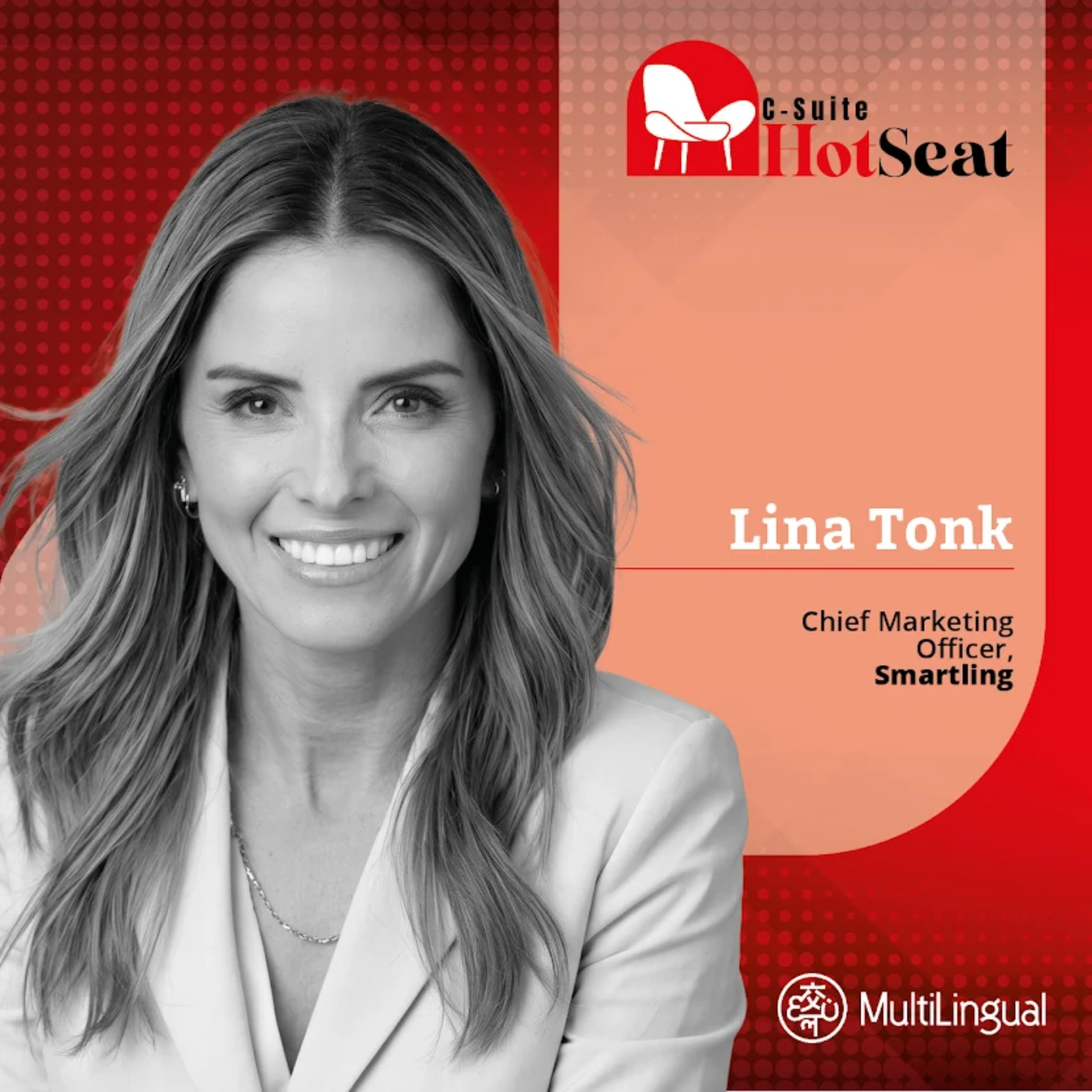
[00:00:08] Speaker A: Welcome to the Hot Seat, the C suite Hot Seat, the podcast where we put language industry leaders in the chair and ask the questions that usually stay off the slide deck. I'm Eddie Afiota, CEO at Multilingual Media, and today we're talking with one of the executives helping shape how AI translation is understood, adopted and trusted by enterprise organizations around the world. Our guest is Lina Tonk, Chief Marketing Officer at Smartly. Lina has spent nearly two decades helping high growth technology companies scale through transformative go to market strategies, AI driven marketing, and customer centric growth. She has led marketing organizations through acquisitions, category shifts and periods of rapid expansion, and helping companies turn innovation into commercial momentum. Today, we're talking about more than marketing. We're talking about leadership, AI hype versus reality, building trust in emerging technologies and what it means to position a company at the center of the most significant transformations the language industry has ever experienced. Lina, welcome to the Hot Suite situation.
[00:01:23] Speaker B: Thank you so much for having me. I'm so excited to be here.
[00:01:26] Speaker A: Fantastic. And of course we have to talk about the elephant in the room. Lina, we are both Colombians.
[00:01:32] Speaker B: Yes, we are. And I'm so excited to finally be together here with you.
We were just talking about how everybody keeps talking to us about each other. So yeah, I'm very proud. Colombian, born and raised, been in the US for most of my adult life. But yeah, I love my Columbia and that's great.
[00:01:55] Speaker A: And yes, we finally met to do a recording. We didn't even meet to have some coffee or to talk about strategies. We meet to have an interview right off the bat. That's a great start to a friendship to colleague. Transformation and collaboration, of course. Elina, we're here to talk about your position and also your professionalism and your growth and how you take and how you perceive artificial intelligence in translation. But let's get started with what you do. For those that might not know you, for those that might not know smartlink and you know, what a CMO does or what you particularly do at the C level. How would you describe what you do at the C level? At smartling?
[00:02:41] Speaker B: Yeah. So first of all, you know, for those that don't know smart lane, which I'll be surprised. Localization if you don't. But you know, we help companies in the easiest way put we help companies grow globally fast without allowing language to become a bottleneck. It's the simplest way I put it out there, you know, and it's all powered through AI combined with expert language services when needed. So my job is a very, very exciting One, you know, I've been samo my whole.
Forever. It feels like you said two decades in marketing, but it's probably even more than that. But my job here, and it's really the reason I came on. Number one, there's a tremendous shift in the industry, what I consider probably the greatest opportunity in an industry right now, not just in software, but also in language and localization. And my job as a CMO is to help the company grow. Yes, but also help our company make the industry better, is how I see the CMO role.
I have been a CMO multiple times and I have arrived to different markets multiple times. And I think the sweetest way to arrive in the part is to leave the market better than when you arrived. And that is what I'm here to do and what I plan to do.
It's this CMO role is also a role that has changed tremendously over the years. Especially within the last three years, it has changed tremendously. So it's more of a growth role. It's a role that definitely helps companies commercially and that's probably where my strength is at, what I like to do.
So I'm in a sweet time of times, I would say. But yeah, that's what I do. I get to also impact the culture of the company. Company, which is really fun for CMOs. We work really closely with HR, with the CEO, with the leadership team to just make sure our employees are happy and we're doing what we're supposed to be doing for them. And it's a great company to be at. I've enjoyed it so much so far. I've been here for about four months.
[00:05:12] Speaker A: Very exciting and very exciting, of course, to bring in new perspectives into different types of industries. This is definitely an industry that it's mature in so many levels. This is an industry that have consultant firms that are focused on the industry. You have specialized roles and bringing your perspective.
It's very interesting. It's very challenging for the industry to start hearing what others see from the outside.
And of course, it gets me thinking about the misconceptions that you see enterprises, corporates, still have about AI in translation. You start seeing what SmartLink does, you see what enterprises are doing, getting from the company and you start noticing probably some of these misconceptions. What have you noticed in this path so far?
[00:06:00] Speaker B: Yeah, so that's so interesting because actually I'm going to take it back a bit because one of the reasons I selected SmartThing was number one, the opportunity in the market, but number two, smartthing had been an AI for long before.
So I, you know, we are many companies are in the new era of AI, where I believe smartling had already had so much background on AI.
So that excite me tremendously. I think the biggest misconception today, and I hear it from, you know, a bunch of my colleagues on any different market, different size companies, whether you're PE or public or whatnot, it's the fact that you have to adopt AI for the heck of adopting AI.
So I think we have arrived to that moment in time where we have to start really showing real ROI for the use of AI. But also it's ROI attached to the reasoning behind it. Like why are you doing it? Right? It's not so we're all doing AI. We're all using this to help us work better every day. But why are you doing it? Is it really making your role better? Is it really advancing what you're trying to do? So I think the misconception is just that is the fact that just use it for the heck of using AI instead of having a purpose. Because the beautiful thing about AI, and I think that's the most exciting part of it, is that it has so many layers to it to like, if you were more intentional about saying, this is what I need to do and this is how fast I need to go with it, this is how fast I need to get to market or whatever you're trying to do.
There is so many possibilities with AI that if you were to start there instead of just like adding tools and, and doing that for the heck of it.
It's catching up with a lot of people right now. It's catching up also globally with a lot of companies like CEOs are starting to receive those bills on the usage internal of AI and they're starting to question like, why are you doing as a function, how is it making us better? What is the ROI behind it?
It's also actually an exciting part that we're living through right now. And I think it's just the beginning of it.
[00:08:46] Speaker A: Yeah, I think you're right and kudos to those that jump right on on the trend. But then all of a sudden they start finding themselves not really understanding and just saying, oh, we just, we just needed to say AI. And I know I'm making a caricature of the situation, but it felt like that where you have a lot of companies and leaders just say, yeah, we are doing AI, but they are not really thinking through the options. And of course that has led to a lot of promises Overhyped promises, especially in language technology. And I understand, of course, because two, three years ago I've been talking to Brian Murphy about agentic yet on a very responsible way. But there are promises that have not been completed in our industry when it comes to language technology. What do you think are some of those overhyped promises?
[00:09:36] Speaker B: I think, think there's layers to that as well. One of the ones is, I think there's, when I talk to localization leaders and even marketing leaders that are actually today owning localization more than it had ever to. Localizations. Moving from different departments is what I've experienced with the industry so far. So some are landing in products, some are landing in marketing teams. A lot are landing in marketing teams. So I've been talking to a lot of CMOs heads of marketing, heads of digital on this. And one of the things that I see is we need, you know, we have an initiative that we just have to use AI for language, for localization. So what is it that we're just going to go ahead and do? So I kind of take it back to the question that you asked me before is like, what is the purpose and what are we doing?
This is what I probably love the most about our strategy and our innovation ahead is the fact, the intentionality of it.
So agents, right, agents became the talk of the town.
Same thing as AI came in. So agentic models, languages, like, how are we going to do that? And behind that, the most beautiful thing is that, yes, you can advance your way into localization and you can do it very rapidly.
Can you trust it? Can you trust that quality?
So I think is the, the agent side of languages that, that was another hype. People get on that hype and not being very intentional on and being very tactical. What is it that I'm trying to accomplish with language?
What is it that I'm trying to accomplish with localization?
I think most of the people that I talk to or that we talk to, there's different layers to this. We are trying to just grow faster. We're trying to grow globally, we're trying to get to people faster, but we're trying to convert them. If you talk CMO language, you have me at conversions, so you say conversions, you have my attention.
And what we're seeing is that not having that intentionality of like, what is it that I'm trying to do so that I can really select what my technology or services can do for me, it is going to be critical because companies today are trying to, to identify, okay, is this good enough to ship. Is this going to be fast enough to ship? I would say that one of the things that is happening right now is how fast we can do it. Anybody that I talk to from a smartlink perspective is, you know, even from to go very tactically as far as connectors. So you connect with this, you connect with that, great.
But you know, it's going to take me couple of months and I'm like, no, like we have that connector, we can plug it in. Like you are ready to go in a couple of days, in a couple weeks, you're up and running and they can't even believe it. So I think the AI, the AI missing piece on the language side, like I think on any industry simply say it is not starting with what problem are you trying to solve for yourself?
What are you trying to do first? And that's when we solve for what you're trying to do. And yeah, that agentic hype is happening. But I also think agents done well and done with that intentionality are absolutely incredible. They're models of trust and quality and speed.
A lot of people don't care as much that level of quality. They care more about the speed on they can do and when it's ready to ship.
So what is it that you're trying to do? There's a lot of people that are just concentrate on quality before anything.
So then we go there. So I think that's the missing piece of the puzzle from my perspective. I don't know if you see that that way too.
[00:14:18] Speaker A: Definitely. And I think it reminds me a lot of the jobs to be done. Conceptualization and the idea that you really have to know and identify what are some of the things that you're working on. And I love what you're mentioning about intention because in the beginning, when we started realizing that artificial intelligence could help with so many things, many professionals and companies kind of like defaulted to AI will do it. And this AI will do it would be like, I don't even have to think about the prompts or the guidelines or the guardrails or the privacy issues. I don't have to think about anything. It's almost like the technology will think for me. And it's almost like taking away the intentionality, the productivity from what we believe. It's what makes everything that we build really human. And I think you are referencing a little bit to what we are not noticing in the technology. And there are so many underrated elements in the conversation. To me, this is one you are very clear on it, which is the Intentionality, I think yes, there are some developments in the way people work in the culture of companies and I'm very curious to understand a little also about the culture of SmartLink and what changes are you seeing? I love to hear what you're saying about the speed of things and the shippability of the solutions. But are there any other underrated developments either on the technology side or the culture side or the business side that you're noticing in the past four months that you've been at SmartLink?
[00:15:55] Speaker B: Yeah, I think the underrated, I think is coming out, and I think I mentioned it a little bit, is the where localization is living today.
It's a very important driver of how localization is going to be presented from a sea level perspective. So the shift on localization, on where it belongs in the org, it almost, it's shifting so much.
I've met with so many localization leaders.
I was just at a dinner with one that say, hey, I just a new CEO a month ago and next week I am to present the investment on localization and what we're doing. And one of the things that they wanted to present obviously was how AI played a part within localization and shippability and the speed of it.
But what was tricky was seeing that they also in many cases struggle showing how attached localization can be to the commercial strategy of the company and the growth, the potential growth of the company.
So I think that's a big piece missing of the puzzle on, you know, our roadshows concentrated. I spend a lot of time on our roadshows, which I learned so much by being there.
It was just my second week at Smartling and that's where I learn and getting to know these people and understanding, oh, it's, it's connecting. That commercial strategy on localization is just not just a team that does languages. It's actually a team that can really speed up your growth.
And when you connect that into, well, we can speed up your growth. But how does that connect to the commercial Strategy and actually KPIs of the company, you know, whether it's our pipeline, your bookings, you know, overall your revenue, how fast you arrive to a market, but how efficient you are when you arrive to that market. I mean, you have my attention.
I've learned also that many CMOs, including me before I met with Brian and SmartLink specifically, if you were to ask us even something as simple to go as an asset, like our website for example, and you said like I asked one of our, of our top sales reps When I first started, I'm like, talk to me like it's our first meeting and I know nothing about localization. I want to know how much I know about localization. And so he started, he started the meeting talking to me about, so tell me about your website a little bit. You're trying to go globally to tell me about your website. Yeah, I know everything about my website. And he says, how many words do you have on your website? I'm like, oops.
Then I went into one of my CMO groups that I chat with them every Friday. They're all like, nobody knew the answer to their actually website word count.
But I gave you that simple example because we don't understand that from a CML perspective. But then from the localization side, it's connecting the dots into how localization and languages can totally fire up your growth and the efficiency on how you arrive to those markets. I am fascinated, Eddie, by how a little thing can, language wise, translation, localization wise, like a CTA can change everything for you in a different market.
If you go and have, you have the technology in place, you have everything you need to change that CTA and how it needs to be done, and then you maybe have some of your local humans take a look at it and you say, I would never click on that, I would never click on that. And then you make those tweaks and changes and then, you know, you're just years ago, your conversion rates spike immediately.
OpenAI had a great chat actually at Lock World about that. And I'm fascinated by just a simple example they gave on CTA changes and what languages did for them for conversion. So I'm looking really closely also personally into that for us. But I think it's something that we should all be looking at the future, to speak a little bit of the future. And what we need to be looking at is the future of what we do has to be driven by the problems we're trying to solve.
So staying incredibly close to our customers and to our market, what problems are they are trying to solve? What are they trying to do?
Does what we do today as far as our technology and services have the answers to that? And can what we have do it at the speed that they need to? And if not, that drives your roadmap. Right?
So I am, that's probably my biggest takeaway from a smartening perspective is how close and intimate and I would use that word because it's so important we are to our customers on understanding where they're going, what they're doing what they're trying to solve, they can drive a lot of what we need to do ahead.
It's a really exciting time, I think, in localization. It's an exciting opportunity to be able to show the world that something as impactful as translation, as a translation strategy, can completely change your growth.
[00:22:23] Speaker A: And this is very exciting because it almost seems like all the paradigms are being deconstructed. And there was huge conversations on automation and huge conversations on quality. And from the conversations we are having in the different channels that we have, we are starting to hear more about culturalization. We're starting to hear more about reaching the objectives. And when you start talking about the objectives, we come back again to what you were mentioning. Intentionality. What are the goals that you're trying to achieve? And in some cases, you look at Argentina, you could say that when you're localizing for Argentina, that grammatically and semantically things are incorrect. But it works because that's how they work, right? They put accents in places where they. It don't go according to the grammatical rules of the Spanish language yet it works. So it is in terms of quality and accuracy and grammar, quote, unquote, it is wrong, but it achieves the objectives. It reaches the intentionality of those that are putting things in place. And what you're mentioning is very underrated, the value that language and culturalization have on the bottom line, which is we want to sell our products, we want to sell our services, we want to share our concepts. In some cases, it's not products, it's a book, it's an idea, our theories, or many other things that are not necessarily related to services and products.
You have had the chance to work with some enterprise clients and some corporate clients. Now I want to get from you a little bit about your sense of what types of challenges you're seeing. And of course, you're going to have to. You're navigating those as you're coming in. What are you seeing? What are some of those objectives that you are seeing? And do they all relate back to the bottom line? I assume bottom lines are different, but what are you seeing?
[00:24:16] Speaker B: Yeah, so there's. I would probably say there's two that I would say are I'm seeing emerge and they're a priority to many. What we're seeing on one hand is, for example, from an LSP perspective. I see it where people or companies are just like overall, they're just trying to get. Get one shot for everything.
Eventually, I think in localization there was this thought process in the past that.
And it could be not just uniquely to localization, that, okay, so if I put my eggs, all my eggs in one basket, like that could be risk.
And that's actually quite the opposite. I actually want to quote our CEO on this because I was sitting at a dinner with him and he made me LA when he said, don't you want to have everything all in one so that you can come yell at me if we're not doing it? All right, but you're just going to that one person. But I'm giving that example because I just think that I'm seeing a lot of emerging on that. We have a lot of our customers that are coming to us and saying, you know what? I had this with this company and this with you.
And obviously, I think a lot of that happens through the speed and the services that we're providing.
Like, they are happy. They're seeing a lot of change with us. They're seeing a lot of investment from our side and our customers. So they'll say, your responsiveness, how fast we're moving with the technology, we're seeing the results. I think I'm going to move this too. So there's a lot of appetite for that. I'm seeing a lot of that emerging up. So that will be one thing that I say is emerging. And it's probably going to accelerate. It's going to happen.
So it's exciting. It's exciting for us. You want all these large enterprises which are amazing brands, you get to meet these people and they're so into their brands and I'm fascinated by them.
And they're seeing the value of doing that and their mentality shifting now into, oh, my God, yes, it's been a game changer for me. Now that I have everything with you, you get it, you understand me, you know where I'm trying to go.
So I think that's one emerging item that I see happening. And then I think the. The other one that is coming up, but it's not new, but it's also kind of attaches into our chat of AI is not only with localization, but there's a lot of CMOs, CPOs that are running localization team members that say, just present to me and give me your AI strategy. So then the team's coming to us and they're saying, okay, we're going to go present what we're doing at a case that we want to go work with you, but we need to just present us an AI strategy. What are we doing?
And that's when you kind of touch into that AI strategy for the heck of it. But there's a lot of good behind there because at the end of the day, what they're trying to really present is the ability to use AI in localization by being faster, by being that intentionality. And what is my AI strategy within localization? Not for the heck of AI strategy. So that's coming up a lot.
There's not just localization as is localization and my AI strategy, how does that work together? And we're seeing a lot of that emerge up on, hey, so we have a strategy going on together right now, but now what is our AI strategy going forward? And that's when we get into, well, let's get into what we can provide that and how we can accelerate it. And seeing those companies go from a slow speed, or what they would call a speed of what they're used to, into a couple of weeks, in a couple of days, they're seeing a difference.
It is the most rewarding and fascinating thing. I think there's no better reward than seeing a customer receive value for what they're signing up for. That is, is the ultimate reward.
And so we're seeing a lot of that. So I think it's twofold on what I'm seeing.
[00:29:12] Speaker A: Fantastic. And thank you. We love to see what satisfies the C level executives in our industry. And we are coming to an end of our conversation. But before we get there, I want some quick answers from you on some of the things that we're interested to know from you about and you can respond as quickly as you can into this section. We're probably gonna add some music afterwards in post production to this sect, but the idea is the following.
We're gonna be putting some questions in there and we hope to get your visceral answers from this and see where we can go with it. So to begin with, could you share with us perhaps a technology that perhaps didn't turn out as impactful as you thought it was going to be? And you bet on that. You said that was gonna be good, and then it just hasn't developed perhaps as fast as you thought?
[00:30:01] Speaker B: This is an interesting question. It's twofold.
ABM Technologies, they can be a game changer, but they can be also, if the timing's not right, it can be the worst thing that you can do. I won't name names, but it can be the best thing you can do and the worst thing you can do as a marketer. If you're not ready for it.
[00:30:27] Speaker A: For those that don't know what it is, could you explain very quickly account based management.
[00:30:32] Speaker B: So there's a bunch of technologies out there and what you do is you're targeting accounts and also to the level of the people now as well.
There are tremendous technologies, but if you are implementing it when you're not ready, I think it could be a mess to your commercial strategy.
[00:30:52] Speaker A: Wonderful. If you were not a CMO in the language industry, what kind of problems would you want to be solving instead?
[00:30:58] Speaker B: Huh? This is great. I love this question. I am big into health and longevity and all of that. So that will probably, that's probably where I would be because of my background. I think localization languages, it's my passion today and it connects a lot with my background. But my second option will probably be in the health space space.
[00:31:25] Speaker A: We'll probably bring you back to one of our other shows called Lang Talent. We have a conference, a virtual conference and maybe we want you to give us some tips and tricks onto how to work, you know, with your full energy. What are some of the habits that we should have as professionals?
[00:31:39] Speaker B: I would love to.
[00:31:40] Speaker A: Oh my gosh. Mila, let's please take some note. I will have Lena Tank in Lang Talent, our virtual event. You'll be great for it. This is the type of topics we like to talk about. Lina. One AI trend you believe in?
[00:31:52] Speaker B: Yes.
Leading by example. It's a trend now. We're starting to see leaders building agents.
Before it was okay, I'm going to hire a team, I'm going to do this.
I personally had to get my hands dirty. I went, you know, haven't coded it since school pretty much, and started getting messy and dirty with it. I think that's a trend that every leader should experience. You have to see how your team is going about it because many of them are learning on the job.
So I would say that's a great trend to have from a leadership perspective. Just get your hands dirty, go build an agent, go do the things that you're asking your team to do.
That will give you a lot of perspective.
[00:32:39] Speaker A: Wonderful. And then one AI trend you don't believe in.
[00:32:42] Speaker B: The first one I said at the beginning of the call, doing AI for the heck of it.
[00:32:46] Speaker A: That's wonderful. A tool you can't live without.
[00:32:51] Speaker B: So easy. Hopspot.
I love marketing automation. So for those of you that don't know marketing automation, it's critical and very important for marketers.
You know, I love my Salesforce through and through as a CRM, but HubSpot has been a game changer for me and I've been on a lot of marketing automation tools and I cannot live without it. I am a reports data geek and it gives me all the goods.
[00:33:24] Speaker A: Wonderful, wonderful to hear. I'm sure the hotspot people would love to hear that too. The hardest leadership decision you've had to make in the last year or in your career. Let's just leave it at your career. Hardest leadership decision.
[00:33:36] Speaker B: Hardest leadership decision.
You know, it's actually pretty personal, switching, leaving the company. I left before because, you know, I've done it multiple times because I think the time has come and I've been very grateful for, you know, the trajectory I've had. But when you build something and, and you make the decision that it's time, it is super hard and it's. I am so grateful that every time I leave, it's as hard and every time I arrive where I've arrived is just as exciting. But it is really hard.
[00:34:17] Speaker A: Very thoughtful of you. The hardest no you've had to say as a cmo.
[00:34:21] Speaker B: The hardest no, huh? That's a good one. Let me think.
Probably. So I'm big because I've been with growth companies. I like investing, so I like, you know, putting proposal after proposal together on investing because I know it's going to return.
So the hardest thing has to be to say no to an investment proposal from a team member that I know is going to work, but I know it's not the right time.
So that's hard for me to say no.
And I've had to do that quite a few times recently because while you build things underneath, you have to kind of wait and be ready. And I'm antsy about, you know, I don't have a lot of patience. I like want to get it done. But you also have to know no. You have to say no. That is not the right time, that the time will come.
[00:35:19] Speaker A: And that is really wonderful to hear from you. A decision you regret, but you learned from.
[00:35:25] Speaker B: I don't like living with a lot of regrets.
I think I like to see it more as I wanna learn from my mistakes more than anything. So just kind of let it go as I regret and just move on and learn from my mistakes.
I think, you know, when you make changes with people as a leader, being in the C suite for as long as I've been, people believe that letting people go is easy and I just don't think it's anything that it will ever get easy.
What I've learned from it in the most beautiful way is understanding and teaching. Like even some of my is that some of us outgrow the company the same way the company outgrows us.
But it's still sometimes not easy because many of them want to stay. And so, you know, I'm learning from that.
[00:36:29] Speaker A: That is a difficult one. And thank you so much for sharing one thing you wish your customers understood about your job.
[00:36:36] Speaker B: Oh, my God, yes.
I think our customers, or many customers believe that marketing to this day does a lot of shiny things.
And today and actually localization, I am super excited that I get to be with a lot of CMOs and realize I was going to arrive to such a big CMO community or, you know, VPs of marketing or digital.
So what I wish they would know is that we are all living through this transformation and that we can all make each other better by learning from each other.
[00:37:21] Speaker A: That is great. And I think it's so true for this community, this localization, language services in general, it's ready for it and we just need to make some tweaks in there. So we're happy to have you in their community. We're thrilled to be learning from you. You Most overrated leadership advice.
[00:37:39] Speaker B: Most overrated leadership advice. Yeah, I think is the not being hands on. Like you have to be so strategic. Your C level. Yes, you'll have to see strategy from the outside, but the overrating part is not getting into the details and not understanding your own function. You know, I talk to people that are like, you know, I'll find out from my team. You know, you have a team that is doing all these things, but when the problem comes, like get deep into it if you have to so that you can help them. So overrated, I think, is not getting your hands dirty when there's a problem. Not getting deep into it. I think it takes more effort to just then get the reporting from the bottom up instead of just, hey, let's get on a session and let's uncover everything that we can together and see if I can help you.
[00:38:37] Speaker A: And we're gonna get some so many nuggets from this conversation. Thank you so much, Lena. The best advice you actually follow?
[00:38:44] Speaker B: Yes.
Never ever stop learning.
[00:38:48] Speaker A: Wonderful. Never ever stop learning. You've heard it here first.
[00:38:52] Speaker B: I think in the AI era, it actually belongs even more than it did. I've actually said this in Pockets podcasts for years and it's in a written paper about me like 15 years ago. To be honest, they never stopped learning. And today more than ever, we're on an era that we're learning.
And I love talking to junior people and telling them, never, ever stop learning, but never stop being just inquisitive about what comes next and how you can learn from others, how you can. And, you know, just this discussion along. Right, Eddie, like we learn something about each other or we are left with something. So never stop learning.
[00:39:40] Speaker A: Yeah. And consolidating that knowledge, teaching others also helps you learn. There's so many ways to make sure that you are moving forward and keep moving forward. And the temptation of large language models is to, for some people, is not to learn, not to push the boundaries. But I found in large language models and AI a huge tool for learning. It is my main source of progress in learning. And I feel like I'm learning faster today and better than I did for. For many years.
[00:40:10] Speaker B: I think you said it just right. I mean, that is that. That's the most exciting part about AI is that it can make you better if you allow it to make you better, even from a learning perspective. Right. I. I was talking to a friend about an agent that I built for my health, and it is hilarious. And I perfect it and perfect it all the time. And. And then I'm. The agent is learning from me. Right. Because I'm giving it all this information and data and don't do this, but you should not be looking at it this way. And. But likewise, I'm learning from my agent when it speed up. So my longevity data that I'm trying to be inquisitive about.
So I think, think it's just learning.
It's also so good for you. It's so good for your health to learn new things every day and hopefully
[00:41:07] Speaker A: you'll monetize it at some point. We'll see if we'll get the Lena agent out there someday. The health agent out there.
Maybe, maybe. Leena, we've come to an end of our conversation. Thank you so much for taking the time to talk to us. Is there anything else you'd like to add or mention to our audience? Audience who are so kind to listen to our chats all the time?
[00:41:31] Speaker B: No, I would just say, Eddie, thank you so much for having me. And I would also want to say that in our market, I said it at Lockwood, I have never arrived to a market that is so welcoming in the most energetic way. And I am so grateful for that. And anybody listening, you know, if you want to learn from each other, I would love that. And I'm all about making new connections. So thank you for having me. I Loved it.
[00:42:05] Speaker A: Wonderful. And of course we'll add to the descriptions to this conversation all the links that you might need to follow Lena. Follow her amazing professional career and we will have have you again in the ecosystem multilingual media. Hopefully we'll meet in person soon, maybe World in Vancouver.
[00:42:25] Speaker B: I will be there. So I can't wait to meet you.
[00:42:28] Speaker A: We'll need to have a chat on health. We'll need to have a chat on productivity for our industry and other CMOs. Maybe we can get some CMOs together to go for a run or something.
[00:42:38] Speaker B: Coffee or something. I love it.
[00:42:40] Speaker A: Absolutely. Absolutely. Lina, thank you so much for your time.
For everyone who has been listening to this conversation, thank you for joining us on the C Suite hot seat again, Lina, amazing professional. Follow her, follow her advice. Follow Smartlini. If you've enjoyed this conversation, you can find more episodes on Spotify, Apple Podcasts and YouTube. Subscribe, rate and share so others can discover the show. I'm Eddie Arrieta with Multilingual Media.
We'll see you next time in the hot seat. Goodbye. Goodbye, Lena.
[00:43:14] Speaker B: Bye. Thank you.